(951) 779-8862

Why Do Some People Develop Uneven Tooth Edges as They Age?
By Inland Choice Dental | March 3, 2026
You’re looking in the mirror, smiling for a photo, or running your tongue across your front teeth, and notice your tooth edges aren’t quite even anymore. One tooth looks shorter. Another has a small chip. The smooth, uniform line you used to have has gradually given way to something rougher and less symmetrical. It didn’t happen overnight, which is part of why it catches people off guard.
Uneven tooth edges are one of the most common age-related dental changes adults experience, yet they’re rarely discussed until someone is already bothered by them. The good news is that these changes aren’t just cosmetic concerns – they’re also clinically meaningful, and most of them are very treatable.
The Biology Behind Changing Tooth Edges
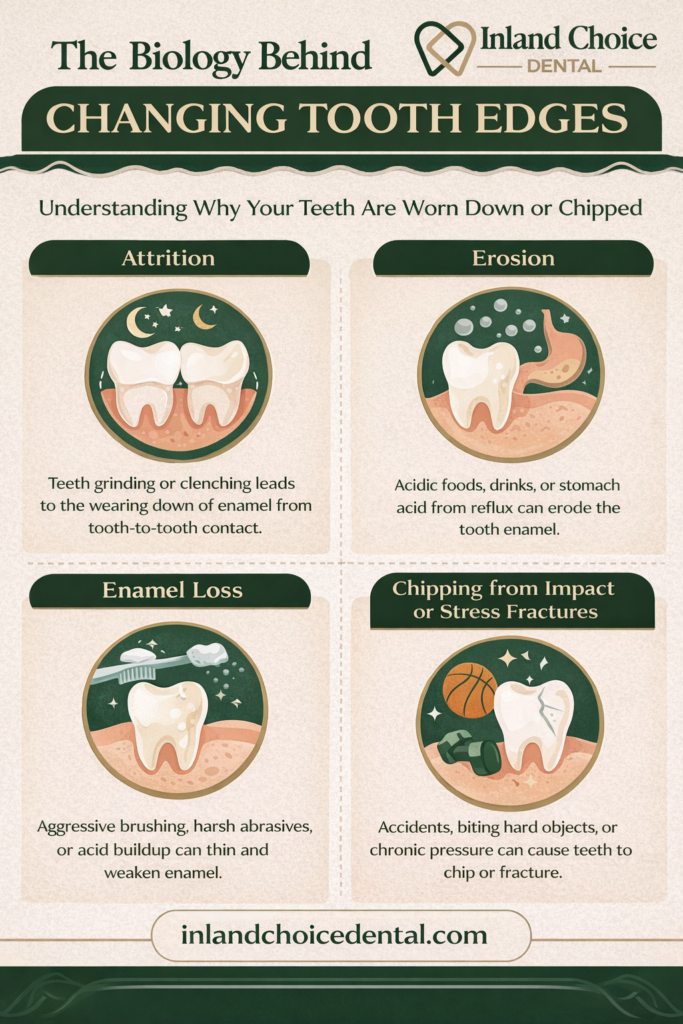
Before getting into what causes uneven edges, it’s worth knowing what your tooth enamel actually is. Enamel is the hardest substance in the human body — harder than bone, but it’s not invincible, and crucially, it cannot regenerate. Once enamel wears away or chips, your body doesn’t replace it. This makes the gradual changes you see in your teeth over time permanent unless a cosmetic dentist in Riverside steps in to address them.
The incisal edges (the biting surfaces of your front teeth) are the most visible and the most vulnerable. They make the first contact with food, absorb repetitive stress from chewing and clenching, and are exposed to the full range of acidic, hot, cold, and abrasive things you eat and drink over a lifetime. It’s no surprise that they change.
What Actually Causes Uneven or Irregular Edges?
Several distinct processes contribute to uneven tooth edges, and most adults are dealing with more than one at the same time. Here’s what’s most often at work:
1. Attrition: The Slow Grind of Daily Biting
Attrition is the wear that results from tooth-on-tooth contact – the natural friction of chewing, biting, and speaking over decades. Every meal contributes a tiny amount of wear to your enamel. Most people don’t notice attrition until their 40s or 50s, when the cumulative effect becomes visible as flattened, shortened, or asymmetrical incisal edges.
For patients who grind or clench their teeth (bruxism), attrition accelerates dramatically. The American Sleep Association estimates that roughly 10% of adults grind their teeth at night, often without knowing it. If your edges have changed noticeably in a relatively short period, bruxism is worth discussing with your dentist.
2. Erosion: The Chemical Side of Enamel Loss
Erosion is different from attrition – it’s caused by acid rather than friction. When acid contacts enamel, it softens the surface and gradually dissolves it. The primary culprits are acidic beverages (citrus juices, sodas, sparkling water, sports drinks), acidic foods, and acid reflux. Dry mouth, which reduces saliva’s natural buffering effect, makes erosion worse.
Erosion tends to affect the entire tooth surface rather than just the edges, but incisal edges are often where it first becomes noticeable. Eroded edges can look translucent, slightly rounded, or cratered. Over time, the same teeth may begin to look shorter overall as the edges thin and chip more easily.
3. Abrasion: What You Do to Your Teeth Without Realizing It
Abrasion is enamel loss caused by external mechanical forces – not biting, but habits. Brushing too hard with a firm-bristle toothbrush is one of the most common causes. Using teeth as tools (opening packages, tearing tags, holding objects) also falls here. Even certain abrasive toothpastes used consistently over the years can contribute to visible wear, particularly on incisal edges and near the gumline.
4. Chipping from Impact or Stress Fractures
A single chip from biting something unexpectedly hard, like a seed, a popcorn kernel, or a piece of ice, can immediately alter the appearance of an incisal edge. Stress fractures are subtler: tiny cracks that develop over time from repeated force and eventually cause small fragments of enamel to break away. Both create the kind of irregular edge that feels sharp to the tongue and looks uneven in photos.
When Uneven Edges Are More Than Just Cosmetic
Most people first notice uneven tooth edges because of their appearance. But the same processes that create irregular edges often have functional consequences that are worth addressing, regardless of aesthetics.
Significant enamel loss exposes the dentin layer beneath, which is softer and more porous. This creates temperature sensitivity and makes the tooth far more vulnerable to decay. Uneven bite edges also change the way your teeth contact each other, which can contribute to jaw soreness, headaches, and accelerated wear on specific teeth.
A jagged edge from a chip can also become a recurring irritation for the tongue and inner cheek. In some cases, it increases the risk of a more significant fracture on the same tooth. These aren’t reasons to panic, but they are reasons to get things looked at rather than waiting.
Treatment Options That Actually Work
The right approach depends on the cause and severity of the unevenness. For most patients dealing with age-related wear, the most effective treatment is:
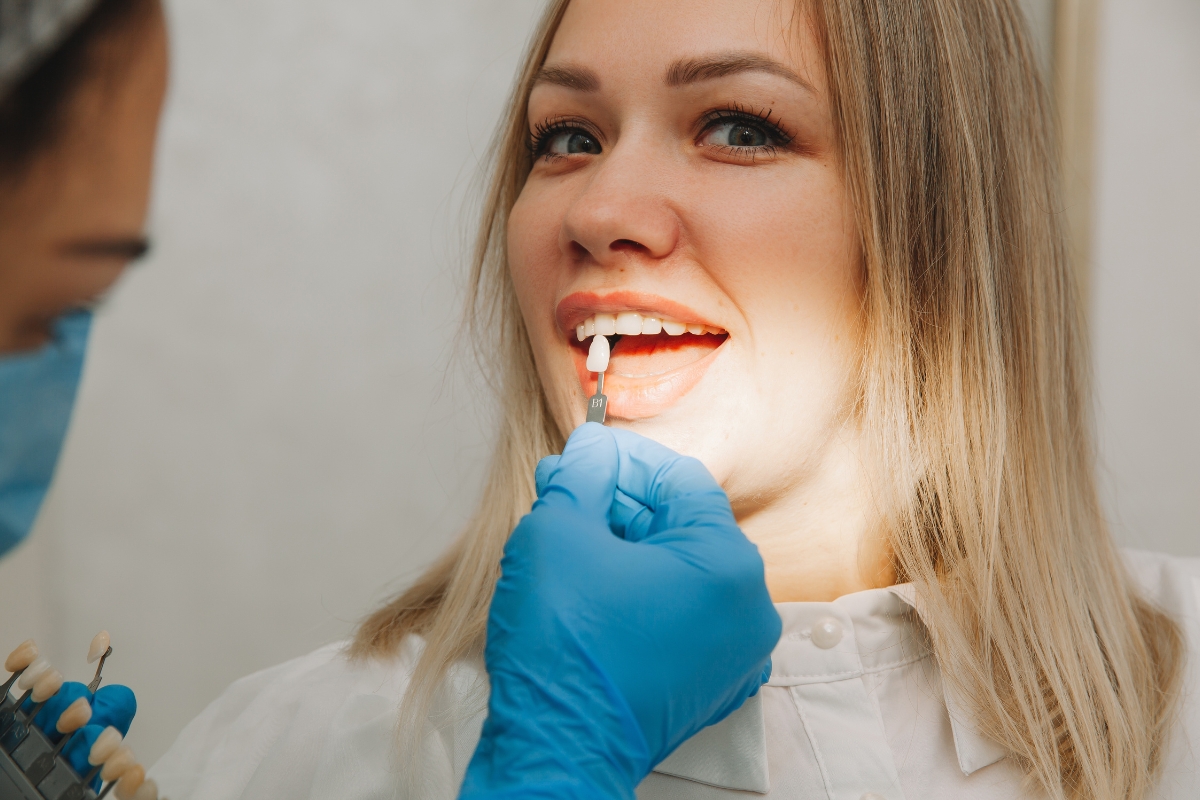
Porcelain veneers: For patients with more significant wear across multiple front teeth, thin porcelain shells bonded to the tooth surface offer a comprehensive, long-lasting correction. Veneers address color, shape, and edge uniformity simultaneously.
Your Teeth Are Telling You Something — It’s Worth Listening
Uneven tooth edges don’t develop randomly. They’re the visible result of years of habits, diet, stress, and biology, and they often signal that something worth addressing is happening beneath the surface. The earlier these changes are evaluated, the more options you have and the simpler the correction tends to be.
Inland Choice Dental offers the full range of restorative and cosmetic solutions described here, from bonding and contouring to veneers and nightguard therapy. Whether you’re dealing with one chipped edge or years of cumulative wear, the right starting point is a conversation with a cosmetic dentist in Riverside who can assess what’s actually going on and outline a clear plan.
Book your consultation at Inland Choice Dental today and get a transparent answer about what your teeth need and what you can do about it.
People Also Ask
Can enamel loss be reversed?
Enamel cannot regenerate on its own – once it’s gone, it’s gone. However, early-stage erosion can be significantly slowed with fluoride treatments, dietary adjustments, and improved oral hygiene. Remineralizing toothpastes containing hydroxyapatite or high-concentration fluoride can help strengthen weakened enamel before it progresses further. For areas where enamel is already lost, restorative options like bonding or veneers fill in what the body can’t rebuild.
Is it normal for adult teeth to get shorter as you age?
Some degree of wear is normal over decades of use. But teeth that appear noticeably shorter, especially in your 40s or earlier, usually indicate attrition or erosion beyond what’s considered typical aging. A dentist can measure tooth length and compare it against normal ranges for your age to give you a specific answer.
How do I know if I grind my teeth at night?
Common signs include waking up with jaw soreness or tension headaches, worn or flattened tooth surfaces, increased tooth sensitivity, and a partner reporting grinding sounds at night. A dentist can often confirm bruxism during a routine exam by examining tooth wear patterns. If you suspect grinding, mention it at your next checkup, even if you’re not certain.
Does dental bonding look natural on front teeth?
Yes, when done well. Composite resin used for bonding comes in a wide range of shades that can be closely matched to your natural enamel color and translucency. The material is also sculpted and polished to mimic the texture and light reflection of a real tooth edge. Most people cannot tell the difference between bonded and natural teeth in everyday interactions.
Should I be concerned about a single chipped tooth?
A minor chip on an otherwise healthy tooth is usually not an emergency, but it’s worth having evaluated promptly. A chip can create a sharp edge that irritates soft tissue, and it also signals that the tooth may be more vulnerable to further fracture. Getting it smoothed or bonded sooner rather than later is simpler and less costly than waiting for the chip to worsen.